
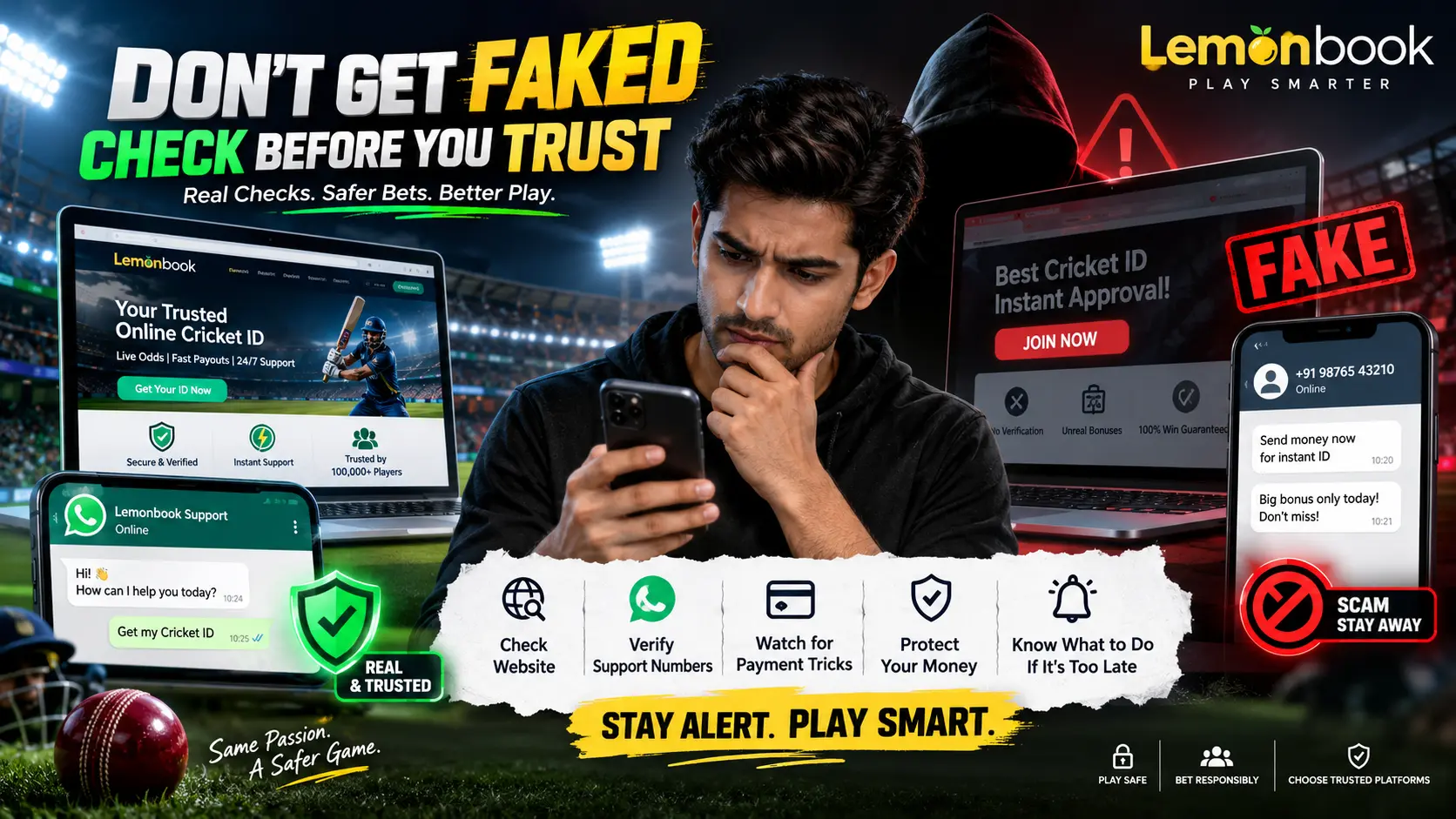
A slick website. A friendly voice on WhatsApp. A steady drip of live match updates. Any of that can make a cricket ID seller look legit. It isn’t. Looks are cheap to fake, and before you hand over your details, follow someone’s odds, or send a rupee anywhere, you need to check a few things first.
This guide walks through how to check a website, spot fake support numbers, catch payment tricks, and protect your money — plus what to do if it’s already too late.
Here’s the short version. A fake cricket ID provider usually does one or more of these:
Pushes you to pay fast.
Hides who actually runs the business.
Keeps switching its UPI account.
Sends you an APK file instead of pointing you to a real app store listing.
Promises a “sure win.”
Blocks your withdrawal, then asks for a new fee to release it.
So before you act on anything, check the website, the phone number, the UPI ID, the rules, and the app. One mismatch is enough. Stop right there.
Before going further — this matters. The Promotion and Regulation of Online Gaming Act, 2025 bans online money games in India outright. It bans the advertising too, and it blocks the money transfers that go with them. On top of that, the Online Gaming Rules, 2026 came into force on May 1, 2026.
Which means an offshore license, a padlock icon in your browser, or even an ID that technically works doesn’t make a money-based cricket service legal in India. Nothing here is an endorsement of betting. This is about not getting robbed.
Before you even reply to a seller, run through this:
Type the website address yourself — never click the link they send.
Look for a real business name and a real address behind it.
Match the phone number against what’s listed on the official site.
Read the payee name carefully before approving any payment.
Check the app’s store listing and what permissions it wants.
Read the withdrawal and account rules, not just the homepage.
Look for actual proof, not screenshots someone could’ve made in five minutes.
Search cybercrime portals and trusted sources for complaints.
If the operator won’t say who they are, if the payment name doesn’t match, or if anyone asks for your OTP or UPI PIN — walk away. You only need one red flag.
Keep this list handy:
The provider hides its real business name.
It only offers a social media account as contact — no address, no company.
The website name is a knockoff of a bigger, trusted brand.
It keeps hopping to new domains.
The payment name doesn’t match the business name.
The UPI ID changes again and again for no reason anyone will explain.
The seller sends you an APK file over chat.
That app then asks for SMS or accessibility permissions.
Support asks for your OTP, your PIN, or remote access to your screen.
The seller promises fixed matches or guaranteed wins.
They rush you to pay before the match starts, like the deal expires.
Withdrawal rules are vague, hidden, or change without warning.
A new “fee” shows up right when your money’s about to leave.
Reviews look copy-pasted or the screenshots look edited.
Support gives you a different answer every time you ask the same question.
Here’s the thing worth remembering: an online cricket ID is just an account used to place bets. No cricket board issues these. There’s no official body behind any of it.
According to Hyderabad Cyber Crime Police, plenty of illegal betting apps in India hook people with big promises — high returns, bonuses, referral rewards, the works. And the fallout isn’t just losing your stake. People lose money, get their personal data stolen, and end up with their banking details misused.
If you’re someone who reuses passwords across accounts — and a lot of people are — one leak on a shady betting site can take down your email, your bank login, your social media, all of it.
The U.S. Securities and Exchange Commission has a name for a specific trick here: advance-fee fraud. Someone tries to withdraw their winnings and gets told there’s a “fee” or a “tax” that needs paying first. Except that fee never actually unlocks anything — it just leads to the next demand, and the one after that.
Betting carries real financial risk regardless of any of this. You can lose everything you put in, full stop. So check your local laws before you even open an account.
For readers in India, the point bears repeating: the Promotion and Regulation of Online Gaming Act, 2025 covers the whole country, including services run from abroad. A company can’t dodge Indian law just by parking its servers overseas.
The tricks aren’t complicated: advance-payment fraud, fake payment pages, data theft, and fees that appear right before a withdrawal. Sometimes it’s a QR code — scan it and your money goes straight to the scammer, or it opens a fake payment page built to lift your login credentials.
An active-looking website or a busy social media feed proves nothing about who’s actually running the show. Profiles get bought. They get copied. And they vanish the second complaints start piling up.
Start with the website itself. Type the address in yourself — don’t click through from a message. Then look closely at the spelling. Swapped letters, an extra hyphen, an odd domain ending, a redirect that dumps you somewhere you didn’t expect — these are all things scammers rely on you not noticing.
Don’t be fooled by the branding either. Live scores, real-time odds, familiar logos — all of that is copy-paste easy. None of it tells you who owns the site.
And watch for the little decorative touches too. A photo of a well-known cricket bat brand on the homepage doesn’t confirm anything about who’s behind it. It’s just wallpaper.
Before you deposit a single rupee, read the privacy policy, the withdrawal rules, and the complaint process. Then search the provider’s name alongside words like “scam,” “complaint,” “withdrawal,” “fraud.” Check more than one source — don’t take a single review’s word for it.
A legitimate business tends to be consistent — same name, same number, same policies, everywhere you look. Vague claims, shifting contact names, instructions that contradict each other from one page to the next — these are the cracks worth noticing.
WhatsApp support feels reassuring, but convenience isn’t proof of legitimacy. If a seller claims round-the-clock WhatsApp help, test it. Ask something specific and see if the answer lines up with what’s actually written on the website.
And keep in mind, HTTPS only secures the connection between your browser and the site. It says nothing about whether the people running that site can be trusted.
Pull up the domain on the ICANN registration data tool and check when it was actually created. Then compare that against any claim like “trusted for ten years.” A domain registered last month obviously hasn’t been building trust for a decade.
Search the exact domain name in quotes too. Look for old reviews, warning threads, archived versions of the page. If you notice a string of near-identical domains, that’s usually a sign the operator keeps relocating every time complaints catch up with them.
That said, an old domain isn’t automatically a safe one — scammers buy aged domains specifically because they look more credible. Combine this check with everything else: the operator’s identity, the payment details, the complaint history.
India’s National Cyber Crime Reporting Portal has a “Report & Check Suspect” tool that lets you search phone numbers, emails, bank accounts, UPI IDs, websites, and apps tied to existing complaints.
A match there is a serious warning sign. But no match doesn’t mean the provider is clean — I4C itself points out that scammers change their details constantly, so the database will never catch everyone.
Before depositing anything, check the minimum deposit, the withdrawal limits, how long processing takes, what documents they’ll ask for, the fees, and the bonus conditions.
If you want to start small without risking much money, you can check out reliable low deposit betting sites that let you play safely. If the site says the minimum deposit is ₹300, that number should be exactly what shows up when you actually go to pay.
Steer clear of any provider whose terms can shift without notice, or one that won’t explain what happens to a restricted account. You should always know, upfront, what happens to your money, your pending withdrawals, or your open bets if your access gets cut off.
If you are checking LemonBook as a cricket ID provider, use the same checks explained in this guide. A trusted cricket ID provider should offer clear business details, easy-to-read terms, and a clear way to raise complaints. Check whether LemonBook meets those standards. Look for independent evidence, and do not rely on branding, chat messages, or payment screenshots alone. Never share your OTP or UPI PIN with anyone.
Be suspicious of huge bonuses, fixed returns, or any promise of a guaranteed profit. Nobody — nobody — knows how a match will turn out ahead of time. A “certain win” claim is a lie by definition.
Urgent messages tied to IPL or T20 matches are another giveaway, especially the ones demanding fast payment before “the odds change.” That pressure exists for exactly one reason: to stop you from stopping and checking.
Never hand over your password, your OTP, your card PIN, or remote access to your device. And treat any request to send money to a personal account as high-risk — especially when the site itself lists a completely different business name.
Don’t let a huge casino game library distract you either. Slots, live dealer tables, card games — none of that says anything about whether the provider handles payments safely or honors withdrawals.
A “dead ID” is an account that stops working right after you pay, or gets blocked almost instantly. The seller goes quiet, deletes their profile, or resurfaces days later with a new number like nothing happened.
The pattern is always the same: you pay first, and the access never actually materializes. Any follow-up request for an “activation,” “reactivation,” or “unlocking” fee is just another squeeze.
A phishing link can mimic a betting login page, a UPI app, even a bank’s payment screen down to the pixel. Type your details into one of those and you’ve just handed criminals your account.
Be careful with ID documents too — sending them to an unverified provider can open the door to identity theft. Only share documents when you know exactly who’s asking, why, and how they’ll store them.
The safest habit is to type in known websites yourself rather than clicking links, and to avoid shortened URLs and QR codes when you can’t see where they actually lead.
Sometimes a seller sends an Android APK file over WhatsApp or Telegram. Don’t install it. A fake app like that can read your messages, steal your login credentials, display a fake balance, or take control of parts of your phone entirely.
Keep Google Play Protect switched on at all times — Google says it scans apps for harmful behavior and can block unverified apps that request sensitive permissions. And actually check what an app wants access to: camera, contacts, SMS, phone, storage, accessibility settings. A cricket app has no legitimate reason to need control over your messages or your accessibility settings.
If an app ever asks you to turn Play Protect off, that’s not a step to follow — that’s your exit sign.
Don’t take five-star reviews at face value. Scammers steal profile pictures, buy comments in bulk, and edit payment screenshots convincingly enough to fool most people. These days even the voices and videos can be AI-generated and still sound like a real person vouching for the service.
Check the dates on reviews and the actual wording used. A cluster of short reviews that all use the same phrases, appearing around the same time, is a tell. Search specifically for complaints about withdrawals, KYC issues, frozen accounts, bad support — the stuff that doesn’t show up in five-star reviews. And check whether promoters actually disclose when content is sponsored.
One glowing review doesn’t cancel out a pile of complaints. Equally, one bad review doesn’t prove fraud on its own. What you’re looking for is a pattern repeated across sources that don’t know each other.
Use a payment method that leaves a paper trail. Before you approve any transfer, check the recipient’s name — if it doesn’t match the business name in the written instructions, stop.
Plenty of providers advertise UPI, PhonePe, Google Pay, Paytm, bank transfers — all of it. That list means nothing on its own. Always check that the actual payment destination matches what’s on the official site.
Never share your OTP or UPI PIN with anyone, for any reason. UPI safety guidelines are explicit about this: you enter your PIN only when sending money, never when receiving it.
Before you pay anything, test the support team. Ask about verification steps, disputed withdrawals, responsible-play controls. Save the answers — you’ll want to compare them against the official policy later.
Ask for the full withdrawal process, how long review takes, what documents are needed, and who to escalate to if something goes wrong. A real provider explains all of this without demanding another deposit first.
Compare any “instant withdrawal” claim against what’s actually written down. “Instant” means nothing if they turn around and demand a fee before releasing anything.
And pay attention to whether the answers stay consistent between the website and the chat. If support keeps steering you back toward depositing more instead of answering your withdrawal question — that’s the warning sign right there.
Some scams let you withdraw a small amount early on, just to earn your trust. Then they push you toward a much bigger deposit. Once that’s in, the account freezes, or a brand-new tax, security, or verification fee appears out of nowhere.
Don’t treat one early successful payout as proof the whole thing is safe. And remember: you should never have to send more money to unlock money that’s already yours. Any legitimate fee will be written into the rules before you ever make a transaction — not sprung on you afterward.
Ask these, and keep the answers:
What’s the full legal name of your business?
Where can I read your complete withdrawal rules?
Why does the payment name not match your business name?
What happens to my data after I close my account?
Who handles complaints if support can’t resolve mine?
A fake provider dodges these, pivots to a sales pitch, or tries to rush you past the question entirely. A real business gives you clear, written, consistent answers — every time you ask.
Before sending money or documents anywhere, work through this: verify the domain and open it yourself. Read the privacy, betting, withdrawal, and complaint policies in full. Compare the payment recipient against the stated business name. Test support with specific, pointed questions. Then pause and actually review what you found.
Here’s the rule worth remembering: one hard-stop is enough. A hidden operator, a mismatched payment name, an APK file, an OTP request, a guaranteed-profit claim, a surprise fee — any single one of these means you stop, not that you weigh it against the good stuff.
Don’t put any weight on screenshots, referral claims, or messages showing “successful withdrawals” either — all of that is trivial to fake or lift from someone else’s account. Set a spending limit before you ever bet, and only risk money you can actually afford to lose. And never raise that limit just to chase back what you already lost.
Picture getting this:
“Instant cricket ID activation through WhatsApp. Pay ₹500 now to my personal UPI account and today’s match profit is guaranteed.”
Look at what’s actually happening in that sentence. The urgency is there to stop you from checking anything. The profit guarantee is a flat-out lie about how betting works. And a personal UPI account, with no written terms anywhere — that alone should be enough to close the chat.
WhatsApp activation and Indian payment support might feel convenient. Convenience was never the thing you were supposed to be checking for.
Stop sending money, documents, anything — immediately. Change any passwords that might be exposed, and contact your bank or payment provider right away if your financial details are at risk.
Save everything: screenshots, transaction references, URLs, QR codes, phone numbers, usernames, full chat logs. Note down the timeline too, because scam profiles and their messages have a habit of disappearing fast.
File a complaint with whatever platform, messaging app, or payment service was involved.
If money has already moved in India, call the national cybercrime helpline at 1930 right away, then file a report at cybercrime.gov.in. Acting quickly gives your bank a shot at tracing or freezing the funds — though there’s never a guarantee you’ll get it back.
When you report it, have this ready: bank or wallet name, transaction ID, date, amount, the website URL, the phone number, the UPI ID, and the full chat history. You can also report a suspicious website, WhatsApp number, Telegram handle, or social profile through I4C’s suspect reporting tool.
If you’ve clicked something you shouldn’t have, change your passwords right away, from a device you trust. Don’t reuse whatever new password you pick anywhere else. Turn on two-factor authentication, and go through your active sessions for anything unfamiliar.
After that, keep an eye on your bank, card, and UPI activity for a while. Any transaction you don’t recognize — report it immediately. Don’t wait to see if it happens again.
There isn’t one. Judge each option on its website, its written terms, its payment process, its withdrawal policy, and its legal status where you live — and ignore anyone promising guaranteed profit.
Fast deposit pressure, copied branding, personal payment accounts, promises of certain profit. Vague withdrawal rules and inconsistent answers matter just as much.
Check the domain, the operator, the policies, the payment recipient, the support responses. Search independently for complaints. Don’t deposit until you actually know who’s running this and how withdrawals work.
No. It doesn’t override Indian law. The 2025 Act applies to any online money gaming service offered inside India, wherever the company is actually based.
Yes, easily. HTTPS only protects the connection between your browser and the site — it says nothing about who owns the business. Reviews get bought, branding gets copied, and withdrawal screenshots get faked just as easily.
Use the “Report & Check Suspect” tool on India’s National Cyber Crime Reporting Portal. You can search a phone number, email, UPI ID, website, or app. Just remember — no result doesn’t mean it’s safe.
 1
1